
CMR claims: do factory rules override the Convention?
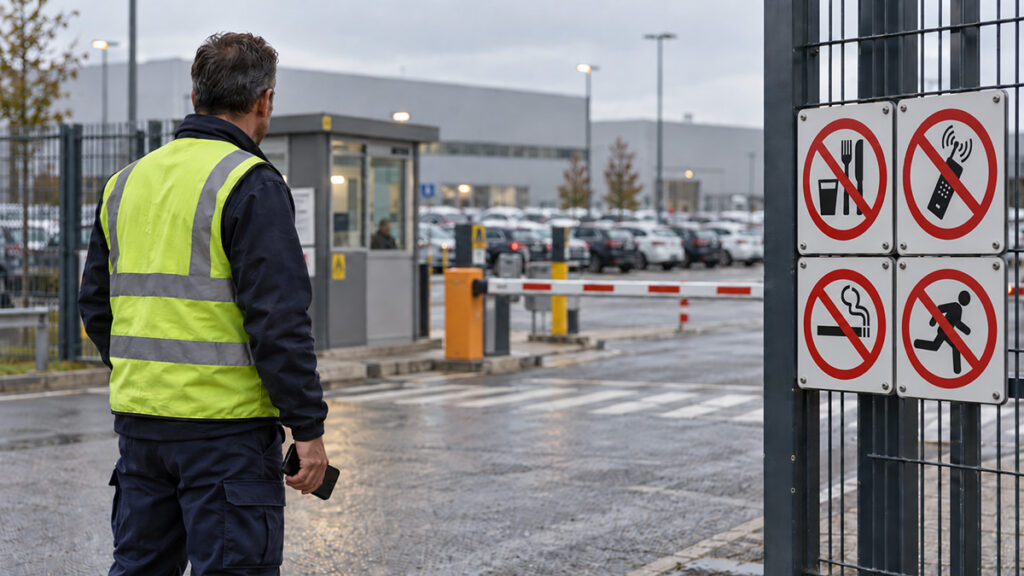
The driver is not allowed to photograph the cargo. When damage is spotted, they are asked not to record it on the consignment note. At delivery, the paperwork is stamped “inspection to follow”.
A few days later, a CMR claim arrives. The explanation is brief: “That’s our procedure. Please arrange payment.”
The transport is complete. But the carrier is left facing a damage bill.
Can a factory, terminal or consignee use its own procedures to rewrite the rules of carrier liability under the CMR Convention?
Site rules are not a blank cheque
Carriers deal with factory, port, logistics centre and dealership requirements every day: speed limits, protective clothing, even a ban on loading vehicles while wearing flip-flops. These are understandable rules, often shaped by practical experience.
The problem starts when internal procedures are used to restrict how cargo condition is documented — or to justify a claim submitted later.
The right to manage a site does not give its operator the right to rewrite the rules of carrier liability.
Where the CMR Convention applies, Article 41 makes contractual provisions that depart directly or indirectly from the Convention null and void. This includes clauses that shift the burden of proof. There is a narrow exception for certain agreements between carriers, but it does not allow factories to create their own liability rules. [1]
So “the carrier knew our procedures” does not settle the matter. The first question is what those procedures actually require — and whether they are compatible with the Convention.
You cannot document the damage. But you are expected to pay.
At collection, drivers can find themselves in a difficult position. They spot damage but are not allowed to photograph it, cannot obtain a separate damage report, or face objections when they try to enter reservations on the consignment note.
A photography ban is not necessarily improper. A site may have legitimate security or confidentiality requirements. But that leaves a practical question: how is the driver supposed to document the condition of cargo they may later be held responsible for?
Article 8 of the CMR Convention requires the carrier to check the apparent condition of the goods and their packaging and to give reasons for any reservations entered on the consignment note. Under Article 9, the absence of specific reservations creates a rebuttable presumption that the goods and their packaging appeared to be in good condition when the carrier took them over. [1]
That is why “don’t write anything down — it’s all in our system” should not remain a verbal assurance.
The carrier needs evidence it can retain: a reservation on the consignment note, an inspection report or a copy of the system record. If you are prevented from documenting the condition of the cargo, notify the party that placed the transport order in writing and ask for instructions. If loading-site staff have recorded the damage, request a document confirming it.
“Inspection to follow” — inspect later, bill the carrier?
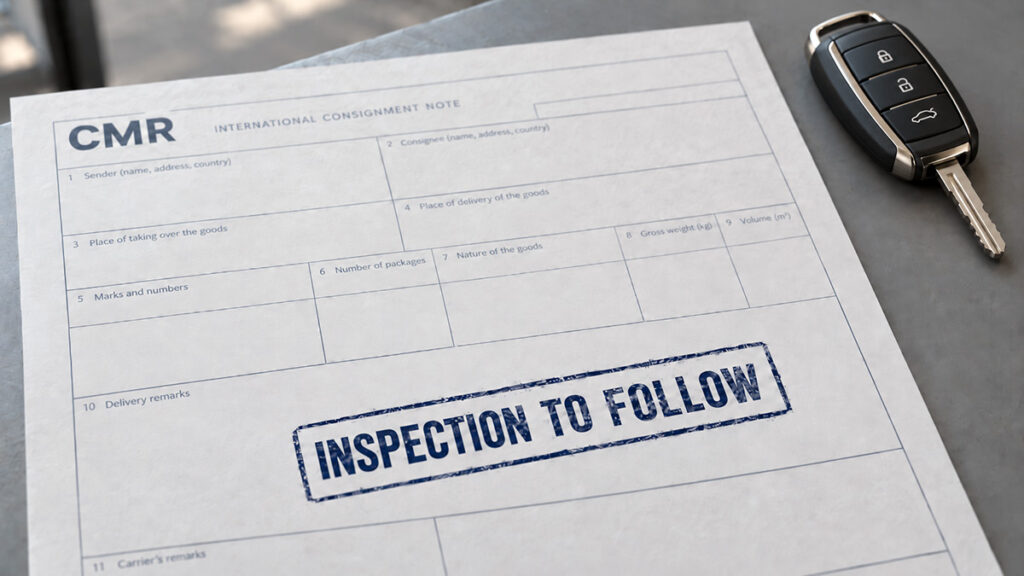
At delivery, consignment notes are sometimes marked with stamps or remarks indicating that the cargo has not been inspected, that inspection has been deferred, or that the opportunity to inspect it was limited.
From an operational perspective, this may be understandable. Vehicles arrive at night, staff are busy, and a detailed inspection takes place later.
But the consignee’s chosen inspection time does not, by itself, establish when the damage occurred.
Three separate questions matter:
-
When was the cargo actually delivered?
-
When was the damage discovered?
-
When and under what circumstances did it occur?
These are not necessarily the same moment. A damage report prepared later may document the condition found during that inspection, but its significance must be assessed alongside the other evidence.
A stamp announcing a later inspection is not the carrier’s advance agreement to pay for everything found afterwards.
Damage reservations: what deadlines does the CMR set?
Article 30 distinguishes between apparent damage and damage that is not apparent at delivery. Reservations concerning apparent damage must be made no later than delivery. For non-apparent damage, reservations must be made in writing within seven days, excluding Sundays and public holidays. The delivery day itself is not counted. [1]
The absence of reservations generally creates a rebuttable presumption that the goods were received in the condition described in the consignment note. It does not automatically invalidate every claim submitted later. Additional rules apply where the carrier and consignee have jointly checked the condition of the goods. [1]
However, a general remark that the cargo will be inspected later does not identify any particular damage. It cannot simply be treated as equivalent to a reservation describing damage found at delivery.
What happened between delivery and inspection?
Consider a new vehicle delivered to a terminal. A detailed inspection takes place several days later and reveals a scratched bumper.
The carrier receives photographs and a repair estimate. But one essential question remains unanswered: what happened to the vehicle before the damage was recorded?
When assessing the claim, establish:
-
who acknowledged receipt of the vehicle, and in which documents;
-
whether photographs were taken at delivery;
-
whether the vehicle was moved, washed, stored or handed over to another carrier;
-
who had access to it;
-
what evidence shows that the damage was already present at delivery.
A gap of several days does not automatically relieve the carrier of liability. But it cannot be ignored when assessing when and how the damage occurred.
A claim describes the alleged loss or damage. It does not, on its own, establish the carrier’s liability.
A forwarder’s backing is not proof of liability
The situation becomes more difficult when the party that ordered the transport, or the freight forwarder, supports the consignee’s demand. The carrier may then feel pressure to pay to protect the commercial relationship.
But forwarding a claim, repeating a payment demand or referring to an important customer’s procedures does not fill gaps in the evidence.
The parties may choose to reach a commercial settlement. That decision should still be informed: which parts of the claim are supported, and what exactly remains in dispute?
How should a carrier respond?
First, do not rush to admit liability simply because the claim comes from a large company.
Preserve the consignment note, delivery confirmations, original photographs, the driver’s account and all correspondence. Build a timeline showing delivery, inspection and notification of the damage.
Ask for specific evidence linking the damage to your transport. If the claimant relies on internal procedures, ask them to identify the relevant provision and explain the basis for applying it.
If the incident may be covered by insurance, notify your insurer in accordance with the policy requirements. However, passing the claim to an insurer does not mean the carrier’s interests will automatically be protected. The carrier should also assess the merits of the claim and the proposed resolution.
In your response, address three questions separately: has the damage been established, is the carrier liable, and is the amount claimed justified?
“That’s our procedure” should invite questions, not end them.
Carriers should respect reasonable loading and delivery-site rules. They are also entitled to expect claims to be assessed against the applicable law and the evidence.
A company’s size, a well-known brand or an established claims process does not make every demand justified.
Internal procedures may determine when the consignee inspects a vehicle. They do not, on their own, determine who pays for the damage found.
Facing a claim backed by little more than “that’s our procedure”?
TruckClaim helps carriers assess CMR claims, examine the evidence and prepare a reasoned response.
Send us the claim, consignment note and damage documents. We will assess the basis of the demand and the available next steps.
Sources
[1] Convention on the Contract for the International Carriage of Goods by Road (CMR), UNIDROIT,8, 9, 30, 40 and 41 articles. Lithuanian text on e.Seimas.